If you only track one marketing number this year, make it your enquiry-to-admission rate. It tells you something ad dashboards can’t: whether your problem is getting enquiries, or turning them into students.
The formula
For a given period (usually a month or an intake):
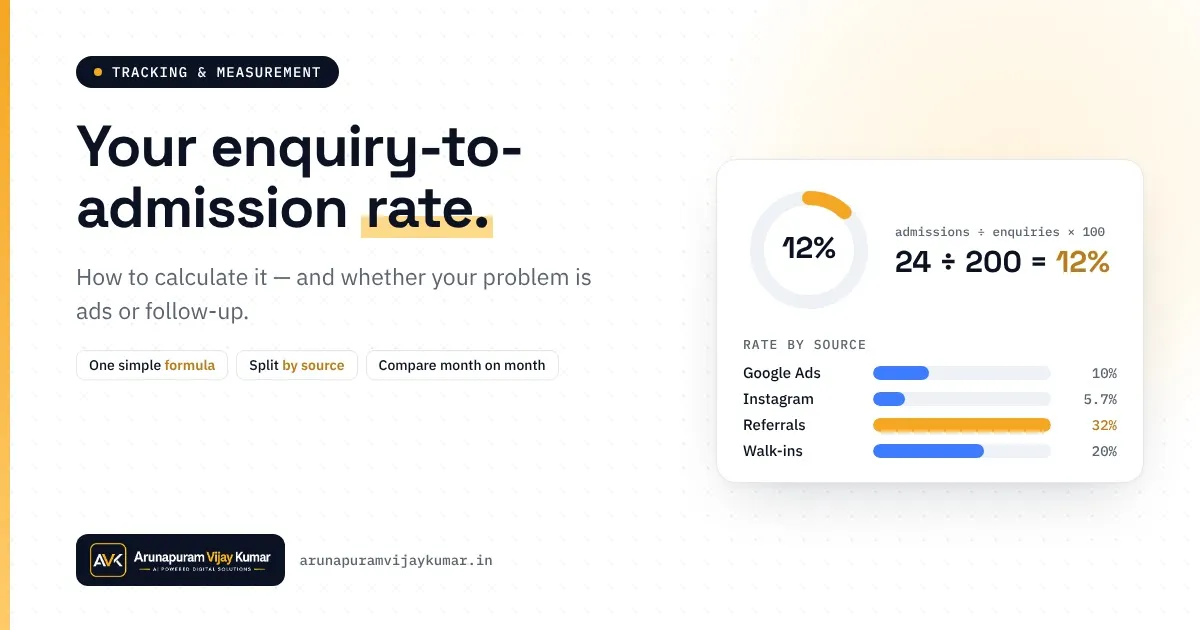
Enquiry-to-admission rate = Admissions ÷ Enquiries × 100
Example: 200 enquiries in March, 24 admissions from those enquiries → 24 ÷ 200 × 100 = 12%.
Two rules keep the number honest:
- Count unique enquiries. The same student filling the form twice is one enquiry.
- Match the period. Admissions should come from the enquiries you’re counting, not from last quarter’s leads.
Calculate it by source
An overall rate is useful, but the real insight comes when you split it by source:
| Source | Enquiries | Admissions | Rate |
|---|---|---|---|
| Google Ads | 90 | 9 | 10% |
| 70 | 4 | 5.7% | |
| Referrals | 25 | 8 | 32% |
| Walk-ins | 15 | 3 | 20% |
Illustrative numbers. In this example Instagram brings plenty of enquiries but few admissions, while referrals convert strongly. That changes where you put budget and effort — something you’d never see from a single overall number.
To do this you need to record the source of every enquiry. If you don’t yet, start with a simple “How did you hear about us?” field and UTM tags on your ad links.
How to read the number
Healthy enquiries, low admissions
This is the most common situation, and the cheapest to fix. The leads are arriving; they’re leaking in response time, follow-up or counselling. Spending more on ads here mostly buys more leaks. Start with a proper follow-up system.
Low enquiries, good admissions
Your counselling works — you simply need more people in the funnel. This is when increasing ad spend, improving your website’s conversion or adding channels makes sense.
Low on both
Fix the basics first: a clear offer, a website that turns visitors into enquiries, and fast follow-up. Then scale traffic.
Common mistakes when calculating it
- Counting admissions from old leads. A student who enquired in December and joined in March inflates March’s rate. Where possible, attribute admissions back to the month they enquired.
- Ignoring walk-ins and phone calls. If only form enquiries are counted, but admissions include walk-ins, the rate looks better than it is.
- Counting junk as enquiries. Wrong numbers and job seekers aren’t real enquiries. Mark them as junk so they don’t drag the rate down artificially.
- Looking at one week. Small numbers swing wildly. Use a month or a full intake.
Five levers that move the rate
- Response time — calling within minutes instead of hours.
- Follow-up depth — four to five touches instead of one.
- Lead quality — ad targeting and landing pages that attract the right students in the first place.
- Counselling quality — counsellors who understand the student’s goal before talking fees.
- Proof — results, reviews and demo classes that answer “will this work for me?”.
Change one lever at a time and watch the rate for a month. That’s how you learn what actually works for your institute instead of guessing.
Track it monthly, compare with yourself
Industry averages are tempting but misleading — course price, city, batch timing and lead source all change the number. The useful comparison is your own rate, month after month. If it rises after you change follow-up, you have proof the change worked.
The free Business Growth Audit estimates your enquiry-to-admission relationship from a few quick questions and shows where you’re most likely losing admissions — in five minutes.
Make it automatic
Calculating this by hand every month gets skipped when things are busy. A connected setup — forms and WhatsApp feeding one lead list, with source and status recorded automatically — gives you the number on a dashboard without extra work. That’s the measurement layer of the Growth System.
Frequently asked questions
What is enquiry-to-admission rate?
It is the percentage of enquiries that become paid admissions over the same period. If you received 200 enquiries in a month and 24 students joined, your enquiry-to-admission rate is 12%.
What is a good enquiry-to-admission rate for a training institute?
It varies a lot by course price, location and lead source, so a single benchmark is misleading. Track your own rate monthly and by source, and focus on improving it over time. A rising rate means your follow-up and counselling are working.
Should I count enquiries from all channels together?
Calculate an overall rate, but also a separate rate for each source. Referrals usually convert far better than cold ad enquiries, and mixing them hides which marketing is actually working.